
Views: 0 Author: Site Editor Publish Time: 2026-07-24 Origin: Site


Commercial fleets are shifting toward alternative fuels to stabilize energy expenses and meet strict emissions compliance mandates. Deploying a natural gas vehicle fleet requires supporting infrastructure that is correctly sized, highly reliable, and aligned with the daily duty cycle of the trucks. Miscalculating station specifications creates severe operational bottlenecks, leading to vehicle downtime, inflated electrical demands, and stranded assets. You must understand the exact mechanical requirements before breaking ground on any site. A CNG Refueling Station operates as a complex processing facility, demanding precise engineering to balance utility gas supply, compression physics, and peak vehicle demand. This guide breaks down how these facilities operate, the distinct configurations available for time-fill and fast-fill systems, renewable natural gas integration, and the engineering criteria required to evaluate a station deployment successfully.
Infrastructure dictates fleet efficiency: The choice between time-fill and fast-fill configurations must directly mirror the fleet’s dwell time and routing schedules.
Inlet pressure is a primary cost driver: The existing utility pipeline pressure dictates the size, cost, and electrical draw of the required onsite compressors.
Storage and dispensing are distinct phases: Efficient stations utilize priority panels and cascade storage systems to maximize the volume of gas delivered to the CNG dispenser without overworking the compressor.
RNG is a seamless drop-in solution: Renewable Natural Gas (RNG) utilizes the exact same CNG fueling station infrastructure without requiring mechanical hardware modifications.
Compliance and maintenance are continuous: Total Cost of Ownership (TCO) must account for strict adherence to NFPA 52 codes and routine compressor maintenance to prevent operational bottlenecks.
A CNG Refueling Station is a purpose-built facility designed to process natural gas for vehicle consumption. It extracts natural gas or biomethane from a low-pressure utility line, compresses the gas, stores it in high-pressure vessels, and dispenses it at 3,600 psi into vehicles. The entire process requires specialized heavy-duty equipment capable of handling continuous industrial cycles.
High-capacity commercial stations are engineered for heavy-duty cycle requirements. They handle massive volumes of gas daily, featuring large industrial compressors and extensive storage banks. These facilities are built to refuel dozens or hundreds of heavy vehicles rapidly. The infrastructure is robust, redundant, and highly monitored by advanced programmable logic controllers.
Residential or garage units operate at vastly different scales. They deliver fuel at very slow rates, often taking over 10 hours to fill a single passenger vehicle. These smaller units lack advanced filtration and heavy-duty dryers. They are limited by standard residential utility connections, and their safety profiles are designed strictly for single-user, low-volume applications.
You should view this infrastructure as a localized processing plant rather than a simple fuel pump. The facility must constantly balance incoming gas supply with compression physics while anticipating sudden spikes in vehicle demand. Proper design ensures vehicles leave with full tanks every time, regardless of ambient temperature or concurrent dispensing loads.
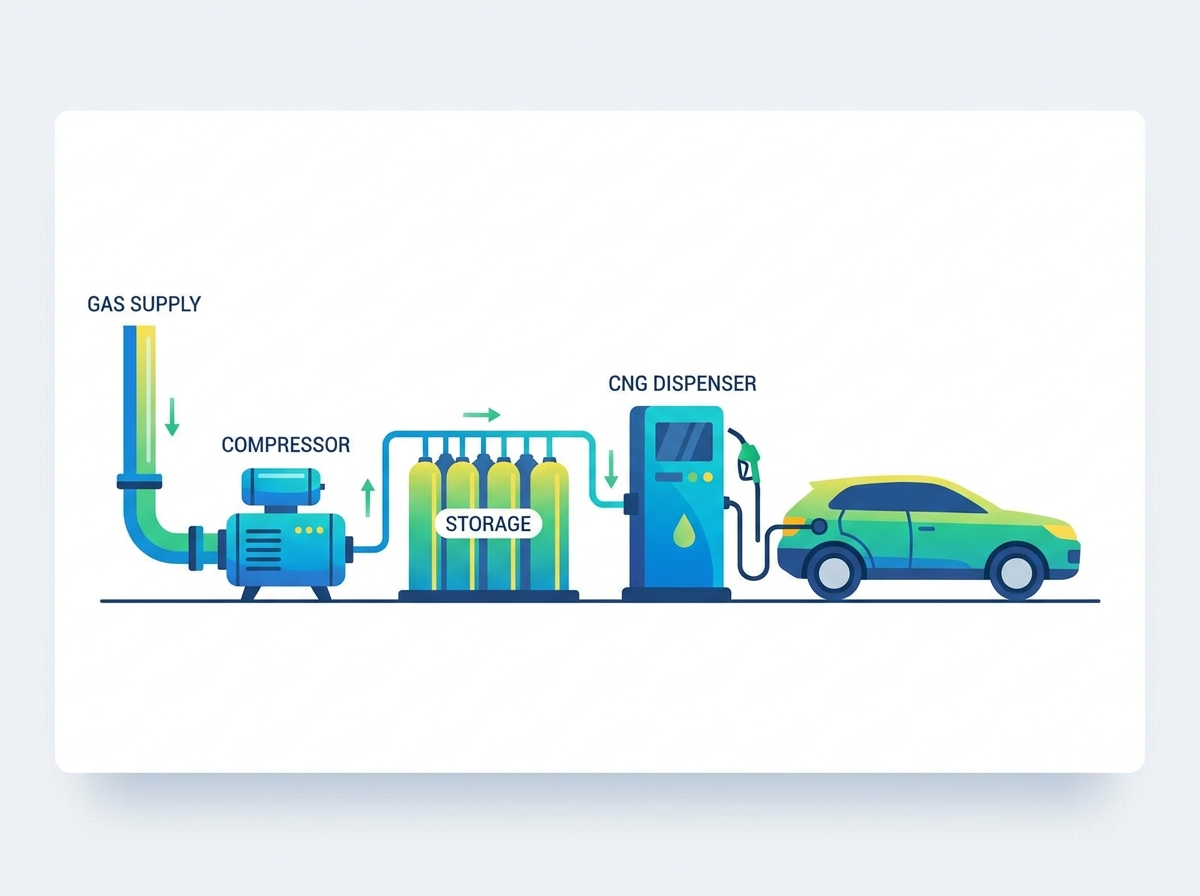
Understanding the gas journey is critical for site planning. The process begins at the utility pipeline. Gas travels through conditioning equipment and into the compressor. From there, it moves into high-pressure storage banks. Finally, it flows through the priority panel and into the vehicle receptacle. Each step requires precise control and monitoring.
These facilities rely entirely on local utility infrastructure, connecting directly to distribution lines. The inlet pressure from this utility line is a critical metric that dictates the entire system's efficiency. Higher inlet pressure reduces the work required by the compressor, lowering energy consumption and reducing equipment wear.
Renewable Natural Gas integrates perfectly into this system. Biomethane is chemically identical to conventional natural gas, acting as a drop-in decarbonization fuel. RNG flows through the exact same distribution pipeline networks. No hardware modifications are required to dispense it, making it a highly attractive option for fleet decarbonization.
Natural gas from the pipeline contains moisture and impurities that you must remove before compression. Moisture can freeze in high-pressure pipelines, severely damage vehicle fuel systems, and accelerate wear on internal compressor components.
Standard desiccant dryers handle this moisture removal. Engineers place these dryers on either the suction side or the discharge side of the compressor. Suction-side drying is common for low-pressure inlets, while discharge-side drying handles high-pressure applications. Automated dew point monitoring ensures the gas remains perfectly dry before entering the storage tanks.
The compressor serves as the core engine of the facility. Multi-stage reciprocating compressors are the industry standard, elevating gas pressure from standard utility levels up to 4,500 psi or higher. This high pressure is necessary for efficient storage and rapid dispensing.
These compressors use multiple cylinders to step up the pressure gradually. Each stage compresses the gas further, while intercoolers reduce the heat generated during this process. Proper cooling is essential to maintain efficiency and protect the equipment. The size and power of the compressor dictate the station's overall throughput capacity.
Efficient dispensing relies on cascade storage systems. This method divides the storage tanks into three distinct banks: low, medium, and high-pressure. This physics-based approach ensures a rapid and complete fill by utilizing pressure differentials to move the gas quickly.
When a vehicle connects, gas flows from the low-pressure bank first. As the vehicle tank pressure rises, the system switches to the medium-pressure bank. Finally, it tops off the tank using the high-pressure bank. This prevents the compressor from running continuously during dispensing and maximizes the volume of gas delivered in a short timeframe.
The priority panel acts as the brain of the gas routing system. It directs gas intelligently based on pressure readings, deciding whether to send gas directly to the dispenser or to refill the storage banks. It always prioritizes filling the high-pressure bank first to ensure the system is ready for the next vehicle.
The CNG dispenser is a highly sophisticated piece of equipment. It utilizes mass flow meters, specifically Coriolis meters, for exact measurement. Temperature compensation algorithms are built into the software to offset the natural temperature rise that occurs during fast-filling. Safety breakaway hoses protect the equipment if a driver pulls away prematurely.
Selecting the right station type is a critical engineering decision dictated entirely by vehicle dwell time, operational schedules, and physical site space. You must match the infrastructure to how the fleet actually operates. Forcing the wrong configuration leads to massive operational failures.
Fast-fill configurations mimic traditional diesel pumps and are designed for vehicles with minimal downtime. Retail stations, continuous-loop transit buses, and heavy-duty trucking fleets utilize this setup to get vehicles back on the road immediately.
This system relies heavily on large cascade storage banks to deliver fuel completely in just three to five minutes. However, fast-fill requires much higher capital expenditure, demands a larger physical footprint for the storage vessels, and creates a much higher peak electrical demand when the large compressors activate.
Time-fill systems are ideal for return-to-base fleets like refuse trucks, school buses, and local delivery vans. These vehicles typically park overnight for six to eight hours, allowing for a completely different refueling approach.
This configuration bypasses large high-pressure storage tanks entirely. The compressor feeds gas directly to a manifold system connected to multiple parked vehicles simultaneously. The compressor runs slowly overnight, filling all vehicles at once. This requires lower capital expenditure and smaller compressors, and it lowers electrical demands by utilizing off-peak charging tariffs. The main drawback is zero flexibility for rapid daytime refueling.
Many sites benefit from integrating both methods to offer maximum operational flexibility. The primary fleet utilizes the time-fill manifold overnight to handle the bulk of the daily fuel demand efficiently.
The site also includes a single fast-fill dispenser supported by a small cascade storage bank. This allows for daytime top-offs if a vehicle runs low, and it can support municipal public access or emergency needs. Hybrid systems provide a safety net for unpredictable operational changes.
Feature | Fast-Fill Configuration | Time-Fill Configuration |
|---|---|---|
Fill Time | 3 to 5 minutes per vehicle | 6 to 8 hours (simultaneous) |
Storage Requirement | Large high-pressure cascade banks | Minimal to no onsite storage |
Ideal Fleet Type | Long-haul, transit, retail | Refuse, school buses, delivery |
Compressor Size | Large, high capacity | Smaller, continuous duty |
Electrical Demand | High peak demand | Lower, off-peak usage |
Evaluating a potential site requires strict technical analysis. Every component must be engineered to match the specific fleet profile. A proper evaluation prevents costly retrofits later and ensures the station performs reliably under peak loads.
Calculating required capacity is the first engineering step. You must determine the Total Gallons Equivalent needed per day and calculate the peak hourly dispensing demand. These two metrics dictate the size of the compressor and the storage vessels.
Undersizing the equipment carries severe risks, leading to incomplete fills and delayed vehicle departures. Oversizing wastes capital on unnecessary equipment and causes inefficient compressor cycling, which accelerates mechanical wear. Precision in sizing is non-negotiable.
An initial utility site feasibility study is mandatory to verify that the local grid can support the facility. There are two primary utility constraints to evaluate: natural gas flow rate and pressure availability, and electrical capacity.
Heavy-duty compressors require robust three-phase electrical service. Many industrial sites lack this specific power requirement initially. Upgrading utility lines can add months to a project timeline. Verify these capacities before signing any equipment contracts or site leases.
Physical space dictates much of the station design. Heavy-duty vehicles require large turning radii and clear approaches to the dispenser lanes. Traffic flow must not create bottlenecks during shift changes. The layout must accommodate the largest vehicle in the fleet.
Safety setbacks are strictly enforced. High-pressure gas storage requires specific property line clearances. Regional codes dictate how close equipment can be to buildings or public right-of-ways. These spatial constraints often force engineers to get creative with equipment placement.
Procurement paths vary significantly. Many operators choose fully skid-mounted, pre-packaged modular systems. These turnkey solutions arrive pre-assembled, including the compressor, dryer, and controls on a single skid. This greatly accelerates site installation and reduces onsite engineering errors.
Alternatively, some sites require custom-engineered integrations. This involves purchasing components individually and assembling them onsite. This approach offers maximum customization for difficult footprints but requires extensive engineering oversight and longer construction timelines.
Operating a high-pressure gas facility involves inherent risks. Safety protocols must be integrated into every aspect of the design. Compliance with national and local codes is mandatory. Cutting corners on safety infrastructure will result in immediate shutdown by authorities.
The regulatory environment governing compressed natural gas is strict. NFPA 52 is the primary code dictating facility design, covering everything from piping materials to setback distances. Local fire marshals enforce these codes rigorously.
Stations require comprehensive emergency shutdown systems. These ESD buttons must be easily accessible. Methane detection sensors are mandatory in enclosed spaces. Automated fire suppression systems may also be required depending on the canopy design. Compliance is a continuous operational requirement.
An NGV fueling station requires rigorous and consistent maintenance. Compressors endure extreme stress and require regular servicing. Valve rebuilds and oil changes are standard procedures.
Desiccant material in the dryers must be replaced periodically. Dispenser hoses require regular pressure testing and visual inspections. High-pressure storage cylinders undergo strict periodic certifications. Ignoring these tasks leads to catastrophic equipment failure and extended fleet grounding.
Fleet operations cannot stop for mechanical failures. Designing for redundancy is the best mitigation strategy. The N+1 redundancy model is standard for critical infrastructure, meaning having one more compressor than is strictly necessary for peak load.
If a primary compressor fails, the backup unit takes over automatically. This ensures fleet operations continue seamlessly during routine servicing or unexpected breakdowns. While redundancy increases initial capital requirements, it protects the core business of moving freight or passengers.
A successful deployment requires aligning the mechanical configuration strictly with the fleet's operational duty cycle. You must respect utility limitations and physical site constraints. Precision in the planning phase guarantees long-term operational reliability.
Initiate a comprehensive utility feasibility study immediately to verify gas inlet pressures and three-phase electrical availability at your chosen site.
Audit your fleet's exact daily fuel consumption and dwell times to determine if a time-fill, fast-fill, or hybrid configuration is required.
Engage a qualified infrastructure engineering firm to map out site turning radii and NFPA 52 setback requirements before finalizing property layouts.
Establish a proactive maintenance schedule for compressor valve rebuilds and desiccant replacements to prevent future operational bottlenecks.
A: Fast-fill stations deliver fuel in three to five minutes using large high-pressure cascade storage banks, similar to retail gas stations. Time-fill stations bypass large storage, using a compressor to slowly fill multiple parked vehicles simultaneously over six to eight hours directly from a manifold.
A: Yes. Renewable Natural Gas is chemically identical to conventional natural gas. It acts as a 100% drop-in fuel. It utilizes the exact same infrastructure, compressors, and dispensers without requiring any mechanical or software modifications.
A: The standard dispensing pressure into a commercial vehicle receptacle is typically 3,600 psi. However, the onsite cascade storage banks hold the gas at much higher pressures, often up to 4,500 psi, to facilitate rapid transfer.
A: No. Commercial fleet applications require industrial-grade utility lines. These lines must provide adequate flow rates and specific inlet pressures. Standard residential or light-commercial gas lines lack the volume required to feed heavy-duty compressors efficiently.
A: Routine maintenance is extensive. It includes regular compressor lubrication, oil changes, and valve rebuilds. Operators must also perform filter replacements, swap dryer desiccant materials, test breakaway hoses, and conduct annual safety inspections on high-pressure cylinders.
A: Yes. Commercial facilities require robust electrical service to power heavy-duty industrial compressors. This almost always necessitates three-phase power. Upgrading a site to handle this electrical demand is a critical early step in facility planning.


