
Views: 0 Author: Site Editor Publish Time: 2026-07-24 Origin: Site


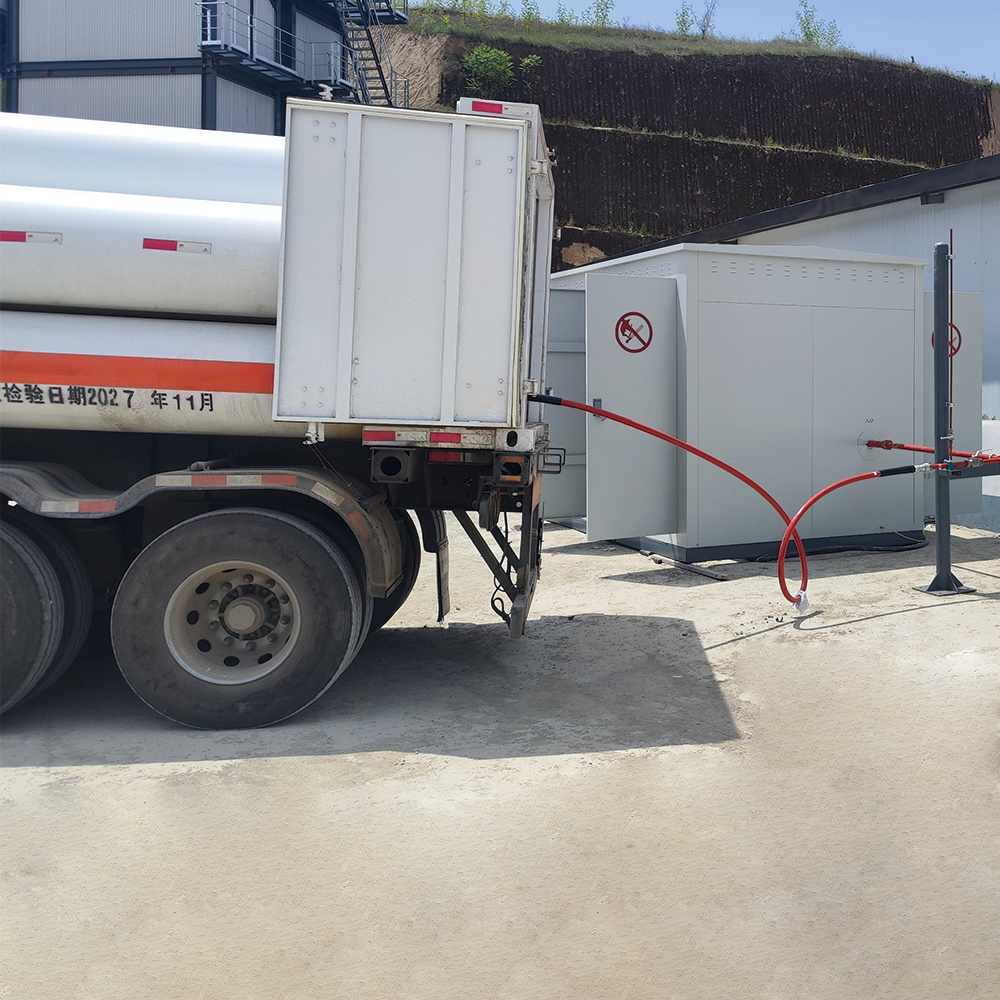
Industrial and municipal capital projects frequently face severe cost overruns and schedule delays. The unpredictable variables of on-site "stick-built" construction derail budgets fast. Field labor shortages, sudden weather disruptions, and the complex coordination of multiple vendors create an environment where controlling expenses becomes nearly impossible. Project managers constantly battle logistical nightmares that drain resources and extend timelines. To combat these challenges, facility owners and engineering firms shift toward off-site fabrication. Specifying a Skid Mounted Regulation Module transfers project risk from the unpredictable field to a controlled manufacturing environment. This approach consolidates engineering, fabrication, and testing into a streamlined process. By moving the bulk of the work off-site, operators achieve predictable costs, accelerated schedules, and superior quality control. You stop managing chaos and start managing deliverables.
On-site fabrication carries compounding costs that quickly inflate project budgets. Traditional construction requires extensive scaffolding, temporary utilities, equipment rentals, and large areas for material staging. These logistical requirements add significant overhead before any actual assembly begins. Managing these temporary site facilities demands continuous supervision and resources. You pay for the crane rental whether it lifts pipe that day or sits idle during a thunderstorm.
Sequential construction further exacerbates these expenses. Crews wait for foundations to cure before piping installation commences. This linear approach means any delay in one phase halts the entire project. The idle time for specialized tradesmen waiting on preceding tasks drives up labor costs and extends the overall schedule. When pipefitters stand around waiting for concrete contractors to finish, your budget bleeds.
| Cost Category | Stick-Built (On-Site) | Modular (Off-Site) |
|---|---|---|
| Site Prep & Staging | Extensive footprint required for raw materials, welding tents, and heavy equipment. | Minimal footprint. Only requires space for the final skid placement and crane access. |
| Equipment Rentals | Long-term rentals for cranes, manlifts, and generators spanning months. | Short-term rentals. Cranes are typically only needed for a few days during installation. |
| Weather Delays | High risk. Rain, wind, and freezing temperatures halt welding and concrete work. | Zero risk for fabrication. Assembly occurs indoors in a climate-controlled shop. |
The modular approach revolutionizes project execution by engineering, fabricating, and testing a complete system on a structural base before shipment. A modular gas skid arrives at the site as a fully integrated unit. This method shifts the majority of the complex assembly work into a controlled factory setting, bypassing the inefficiencies of field construction. You get a product built on a shop floor, not in a muddy trench.
Evaluating modular versus traditional construction requires looking at specific success criteria. The primary metrics are total installed cost, time-to-market, and lifecycle reliability. When analyzing these factors, modular systems consistently outperform stick-built methods by offering predictable pricing, faster deployment, and verified operational integrity. The financial baseline shifts from variable field estimates to fixed factory quotes.
Managing dozens of separate sub-contractors on-site generates massive administrative and overhead costs. Each vendor requires separate contracts, safety orientations, and daily coordination. Miscommunication between different trades often leads to clashes, rework, and scheduling conflicts. The project management team spends excessive time resolving disputes rather than advancing the project. You end up acting as a referee between the electrical contractor and the piping crew.
Consolidating design, procurement, assembly, and testing under a single-point modular partner drastically reduces overhead. You deal with one vendor for the entire system. This streamlined communication ensures accountability and eliminates the chaotic coordination typical of multi-vendor field sites. If a valve does not fit, the fabricator fixes it in their shop before you ever see it.
Specialized field contractors command high hourly rates, often compounded by travel, per diem, and hazard pay. In contrast, dedicated shop technicians operate at more stable and generally lower rates. Productivity levels in a factory are significantly higher due to optimal working conditions and immediate access to tools and materials. Shop fabrication eliminates the non-productive time spent mobilizing and demobilizing on a construction site every single day.
A smaller on-site footprint reduces the need for large field crews. Fewer workers on site means reduced logistical support, such as temporary housing, parking, and sanitation facilities. This reduction in field personnel directly translates to substantial savings in direct labor and indirect support costs. You stop paying for the massive hidden infrastructure required just to keep a hundred guys working in the field.
A self-contained structural skid reduces the requirement for complex, multi-tiered concrete foundations. The rigid base frame distributes the equipment load evenly, often requiring only a simple, flat concrete pad or basic pier system. This simplification cuts down on excavation, concrete pouring, and curing time. You pour a slab, let it cure, and you are ready for the equipment.
Furthermore, modular designs minimize structural steel erection and on-site welding requirements. Because the equipment is pre-mounted and piped on the skid, the need for extensive field-fabricated supports is eliminated. This reduction in heavy civil and structural work accelerates site preparation and lowers material costs. The site civil contractor finishes their scope weeks earlier.
Controlled factory environments allow for precise inventory management and bulk material purchasing. Fabricators utilize advanced software-driven piping nesting to maximize material usage. This precision significantly minimizes scrap metal and piping waste compared to field cutting and fitting. When a shop cuts pipe, they use the off-cuts for the next spool. In the field, those off-cuts usually end up in the dumpster.
Indoor storage protects sensitive components from weather degradation, reducing material loss. The ability to pull exact lengths of pipe and exact quantities of fittings from a centralized shop inventory prevents the over-ordering typical of field construction. These optimized material practices directly lower the procurement costs for the project. You only pay for the steel that actually goes into your system.
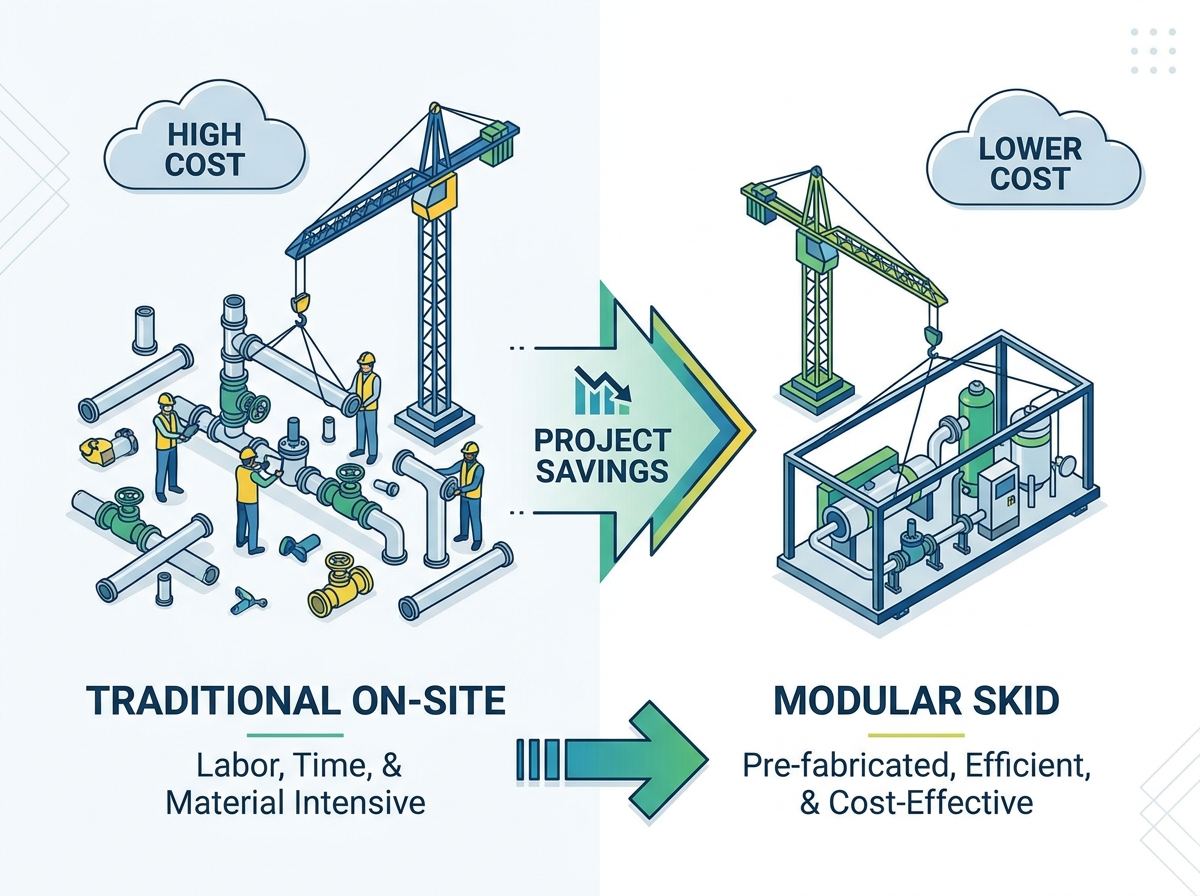
The installation mechanics of an integrated regulation skid are remarkably straightforward. The process involves lifting the unit into place, making single-point tie-ins for inlet and outlet piping, and connecting power and controls. This "plug and play" functionality bypasses the tedious process of assembling individual components in the field. You drop it on the pad, bolt it down, and weld the main headers.
This streamlined approach reduces on-site integration time from months to mere days. Because the internal piping, wiring, and instrumentation are already completed and tested, field crews only need to focus on external connections. This rapid installation drastically cuts down on expensive field labor hours. The electrical crew pulls one main power feed to the skid's junction box instead of wiring fifty individual instruments.
Weather-related downtime in traditional construction carries a severe financial impact. Rain, snow, extreme heat, or high winds halt field welding, lifting operations, and concrete pouring. These delays force contractors to pay idle crews and extend equipment rental periods, quickly inflating the budget. You cannot weld high-pressure gas pipe in a torrential downpour.
Indoor fabrication isolates the critical path from seasonal disruptions. The module is built in a climate-controlled environment, ensuring uninterrupted progress regardless of outside conditions. This predictability allows project managers to maintain strict adherence to the project schedule. While your site is buried in snow, your regulation system is being fully assembled and tested indoors.
Bringing a facility online weeks or months ahead of a traditional schedule offers immense financial benefits. Faster commissioning means the plant begins production sooner, leading to earlier revenue generation. This accelerated timeline improves the project's return on investment. Every day the plant runs earlier is a day of product sold.
For municipal projects, faster deployment means quicker resolution of infrastructure bottlenecks. The financial advantage of early operation often offsets any initial premium associated with modular fabrication. Time saved on construction translates directly into operational profitability. You stop spending capital and start generating cash flow much faster.
Shop fabrication allows for rigorous testing protocols prior to shipment. Technicians perform hydrostatic, pneumatic, X-ray, and electrical continuity tests in a controlled setting. This comprehensive Factory Acceptance Testing ensures every weld and connection meets strict quality standards. You verify the entire system works before it ever goes on a truck.
Identifying and resolving a defect during FAT is exponentially cheaper than discovering it during Site Acceptance Testing. Fixing an issue in the shop requires minimal effort, whereas field repairs involve mobilizing specialized personnel and equipment. Thorough FAT guarantees the unit arrives ready for immediate, trouble-free operation. You do not want to find a pinhole leak in a weld when the skid is sitting in a remote field two hundred miles from the nearest machine shop.
| Testing Protocol | FAT (Shop Environment) | SAT (Field Environment) |
|---|---|---|
| Hydrostatic Testing | Easy water source, controlled drainage, immediate repair capability. | Requires trucking in water, managing wastewater disposal, weather dependent. |
| X-Ray / NDE | Dedicated radiography bays, no disruption to other workers. | Requires clearing the site, halting all other work for radiation safety. |
| Loop Checks | Simulated I/O testing with shop power and controlled software environments. | Dependent on site power availability and final DCS integration readiness. |
Designing an integrated regulation skid in a 3D environment allows for superior thermodynamic layout engineering. Engineers optimize pipe routing to minimize pressure drops and thermal losses. This precise digital planning ensures the most efficient physical arrangement of components. You eliminate the field-routed piping clashes that force operators to add unnecessary elbows and friction points.
Factory-installing optimal thermal insulation, heat tracing, and integrated heat recovery systems reduces long-term utility consumption. Applying insulation in a shop environment ensures a tighter, more uniform fit compared to field application. These integrated energy-saving measures provide ongoing operational savings throughout the equipment's lifespan. The insulation stays dry and intact because it is applied indoors and sealed before shipping.
Modular designs utilize standardized, accessible layouts that simplify routine maintenance. Consistent component placement allows operators to quickly locate valves, instruments, and filters. This standardization reduces operator training time and minimizes the risk of errors during maintenance procedures. When every skid looks the same, your maintenance crew knows exactly where to find the blowdown valve.
Ergonomic design is easier to achieve and verify in a 3D-modeled modular build. Engineers ensure adequate clearance for tool access and safe lifting of heavy components. This focus on maintainability reduces downtime during scheduled outages and lowers long-term maintenance costs. You do not have to build temporary scaffolding just to pull a regulator cartridge.
Modular construction correlates with a significant reduction in on-site hot work, working at heights, and heavy lifting. Moving these high-risk activities to a controlled factory floor lowers the project's Total Recordable Incident Rates. A safer site protects workers and prevents costly accident-related delays. You remove the welding sparks, the grinding dust, and the suspended loads from your active facility.
Improved safety profiles negotiate lower project insurance premiums. Insurers recognize the reduced risk associated with off-site fabrication. Demonstrating a commitment to safety through modular construction provides tangible financial benefits in the form of reduced liability costs. Fewer man-hours in the field mathematically equals fewer opportunities for recordable incidents.
Modular construction requires earlier design freezes and more intensive Front-End Engineering Design. Because the skid is built off-site while civil work occurs on-site, all connection points and dimensions must be finalized early. This necessitates a rigorous and detailed engineering phase. You cannot figure out the piping layout as you go; it must be perfect on paper first.
Late-stage design changes are significantly more costly in a modular workflow. Once fabrication begins, altering the skid layout causes major delays and rework. Project teams must commit to the design early to realize the full cost benefits of the modular approach. If you decide to change a valve size after the steel frame is welded, you pay a heavy penalty in the shop.
Shipping large modules involves physical limitations such as highway weight limits, overpass clearances, and escort requirements. Logistics teams conduct detailed route surveys to ensure the skid reaches the site safely. These transportation constraints dictate the maximum allowable dimensions of the module. You have to know the bridge heights between the fabrication shop and your facility.
Project managers calculate whether freight costs offset fabrication savings for ultra-large systems. In some cases, massive units split into multiple smaller skids to avoid exorbitant oversized freight costs. Careful logistical planning is essential to maintain the financial viability of the modular strategy. A skid that requires police escorts and utility line lifts across three states will eat into your cost savings quickly.
Precise site preparation is an absolute necessity for modular integration. The foundation anchor bolts must perfectly match the skid's structural footprint. Any discrepancy between the site foundation and the skid dimensions causes severe installation delays. You cannot stretch a steel skid to fit anchor bolts that were poured two inches out of square.
Surveyors verify all field dimensions before the skid arrives. The tight integration tolerances require excellent communication between the site civil contractor and the off-site fabricator. Proper alignment ensures the unit drops into place seamlessly. When the crane lowers the module, it should slide right over the bolts on the first try.
While a skid mounted regulation module requires rigorous upfront engineering and logistical planning, the reduction in field labor, schedule compression, and quality assurance overwhelmingly drive down the Total Installed Cost. Transferring the complex assembly to a controlled environment mitigates the risks that typically plague capital projects. You trade field unpredictability for factory precision.
A: Savings typically range from 15% to 30% of Total Installed Cost. This percentage is heavily dependent on local field labor rates, site conditions, and the complexity of the required system.
A: A realistic timeline is typically 12 to 24 weeks. This duration depends on material lead times, engineering complexity, and the specific testing requirements dictated by the project.
A: Standard shipping dimensions are roughly 8.5 feet wide by 40 feet long. Larger systems are often split into multi-skid modules to avoid exorbitant oversized freight costs and logistical hurdles.
A: While the skid provides structural support for the equipment, a flat, load-bearing concrete pad or pier system is still required at the installation site to ensure stability and proper leveling.
A: FAT involves simulating operational conditions, including pressure testing, leak detection, and control panel loop checks. This process is often witnessed by the client virtually or in person to verify functionality.
A: Highly regulated or remote sectors such as natural gas transmission, chemical processing, water/wastewater treatment, and power generation benefit significantly, especially where field labor is scarce or expensive.


