
Views: 0 Author: Site Editor Publish Time: 2026-07-31 Origin: Site


In industrial and municipal gas distribution, precise pressure reduction is non-negotiable for safe burner operation and efficient combustion. The physical footprint of these systems is increasingly under scrutiny by facility engineers and project managers. You must choose between constructing a traditional, built-in-place gas regulation station or specifying a pre-engineered Gas Pressure Regulating Cabinet. This decision directly impacts site footprint, installation timelines, regulatory compliance, and long-term maintenance access. Selecting the wrong infrastructure can lead to spatial bottlenecks, weather-related degradation, and extended commissioning delays. This guide provides an objective, engineering-focused comparison of both approaches. We evaluate them across spatial requirements, safety compliance, installation efficiency, and implementation risks. You will learn how to specify the optimal infrastructure for your site requirements based on hard engineering data and field realities.
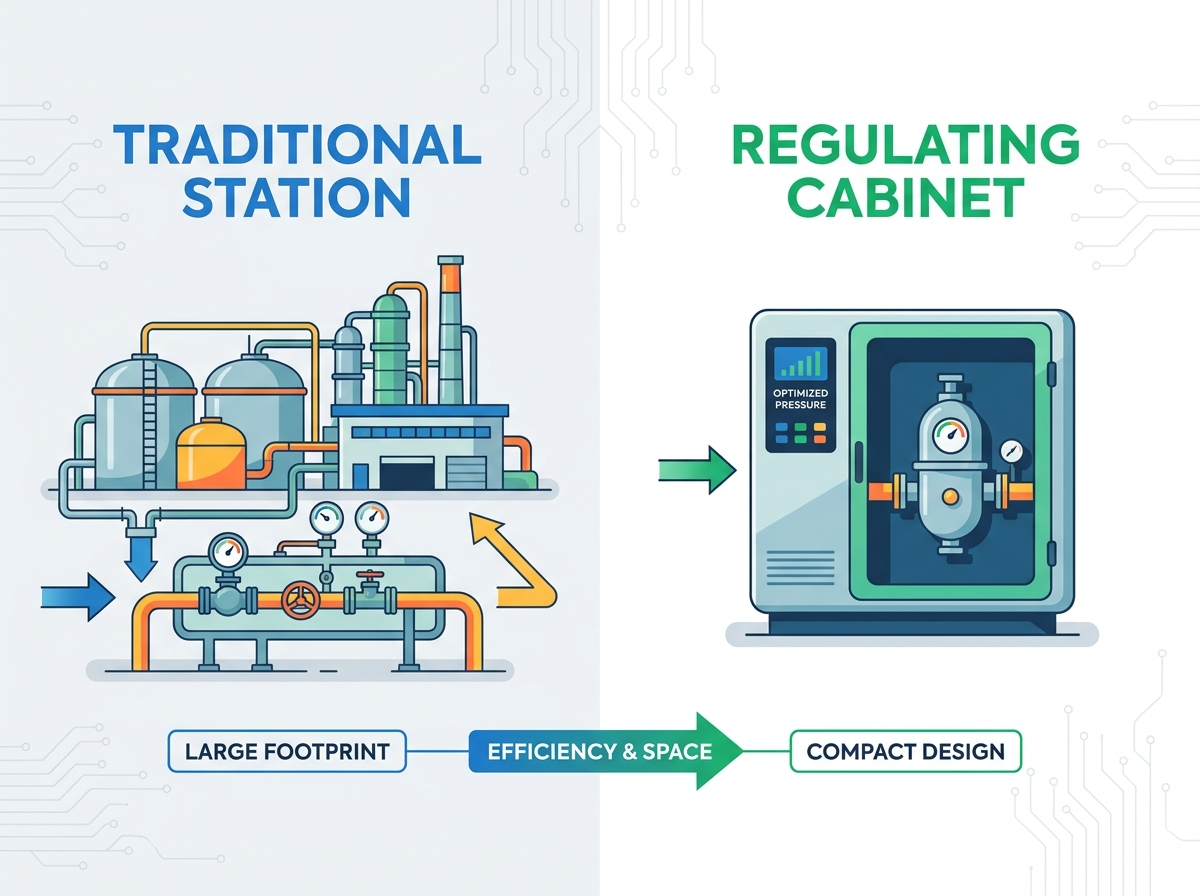
The traditional gas station represents a sprawling, open-air pressure regulation facility. Construction crews build these custom-housed stations from the ground up directly on the project site. They consist of large-scale headers, multiple regulator runs, and extensive piping networks. You will also find separate structural supports anchored deep into concrete foundations. These facilities serve as high-volume interconnects. They bridge the gap between utility transmission pipelines and local distribution systems. Their massive scale accommodates extreme flow rates. Engineers design them to handle the highest capacity demands of regional gas networks. However, this scale requires significant land allocation. Construction involves complex logistics, extended timelines, and multiple specialized contractors working simultaneously on site.
Site preparation for a traditional build involves extensive earthwork. Contractors must pour large concrete pads and install deep grounding rings. Welders fabricate the pipe spools on site using TIG and MIG processes. Every weld requires non-destructive testing, usually through radiography or ultrasonic inspection. This field fabrication introduces variables like weather delays and material staging challenges. The open-air design leaves the piping exposed to the elements. Operators often need to build secondary structures or fencing to secure the perimeter. The sheer physical size means these stations are usually relegated to industrial outskirts or dedicated utility parcels.
A Gas Pressure Regulating Cabinet is a fully integrated, skid-mounted system. Manufacturers house the entire assembly within a purpose-built enclosure. This design offers a true plug-and-play solution for gas distribution. Technicians complete all factory welding and non-destructive testing off-site in a controlled environment. The system arrives pre-calibrated and ready for immediate tie-in. It consolidates filtration, pressure reduction, metering, and overpressure protection into a single compact gas station. This integration eliminates the need for sprawling pipe runs. The modular approach standardizes the installation process. It significantly reduces site disruption and minimizes the footprint required for safe operation.
Factory assembly guarantees a higher level of quality control. Welders work in clean, indoor environments free from wind and rain. The enclosure itself is typically fabricated from heavy-gauge steel or aluminum. It features specialized coatings to resist corrosion. Inside, the layout is highly optimized. Engineers use 3D modeling to pack the necessary valves, regulators, and sensing lines into the smallest possible volume. This dense packaging requires careful consideration of maintenance access. Doors and removable panels are strategically placed to allow technicians to reach critical components. The entire unit is lifted onto a pre-poured pad and bolted down, reducing civil works to a bare minimum.
Gas regulators rely on a precise mechanical force balance. Inside the device, a diaphragm or piston interacts with a spring and a valve plug. These components dynamically control gas flow and pressure. The spring applies a downward force to open the valve. Downstream gas pressure pushes back against the sensing element to close it. This mechanism responds instantly to fluctuating inlet pressures. It ensures safe, stable downstream delivery. Proper regulation prevents catastrophic equipment damage. It maintains the exact pressure required for efficient combustion. Understanding this force balance dictates the selection of the right regulator type for your specific application.
When gas passes through the regulator orifice, its velocity increases while its pressure drops. This creates a dynamic environment where the sensing element must constantly adjust. Pilot-operated regulators use a secondary, smaller regulator to load the main diaphragm. This provides extreme accuracy over a wide range of flow rates. Direct-operated regulators rely solely on the main spring. They are simpler and respond faster to sudden load changes. The choice between pilot and direct operation depends on the downstream equipment requirements. Burners with high turndown ratios often need the precision of pilot-operated units. Simple heating loads may operate perfectly well with direct-operated models.
Traditional stations require massive square footage. They often demand large plots of land with extensive setback distances. In contrast, a compact gas station requires a fraction of the space. This drastic reduction impacts real estate acquisition requirements. You can install compact units near the actual point of use. They fit easily adjacent to industrial boilers or tight municipal borders. Urban environments heavily favor the cabinet approach. Land scarcity makes sprawling open-air stations impractical. The smaller footprint also simplifies site preparation. It reduces the volume of concrete required for foundations and structural supports.
Consider a facility upgrading its boiler plant. A traditional station might require a dedicated 50-by-50-foot compound. This eats into valuable parking or expansion space. A cabinet system handling the same flow might only need a 10-by-10-foot pad. This spatial efficiency allows engineers to place the regulation equipment closer to the burner train. Shorter downstream pipe runs reduce pressure drop and improve response times. It also minimizes the amount of large-diameter, low-pressure piping required inside the facility. The compact nature of the cabinet fundamentally changes how site planners allocate space for utility infrastructure.
Open-air traditional stations face constant environmental threats. They are vulnerable to UV degradation, freezing rain, and wind-blown debris. Extreme weather accelerates component wear and increases maintenance frequency. A dedicated regulating enclosure mitigates these risks entirely. It shields sensitive components from harsh elements. The enclosure extends the lifespan of valves, meters, and sensing lines. It also maintains stable ambient temperatures around the equipment. Temperature stability is vital for accurate pressure sensing. It prevents the freezing of pilot lines during rapid gas expansion. Enclosures also provide a robust barrier against vandalism and unauthorized access.
Freezing is a major concern in gas regulation. The Joule-Thomson effect causes gas temperatures to drop significantly as pressure is reduced. If the ambient temperature is already low, moisture in the gas or on the exterior of the equipment can freeze. This ice can jam moving parts or block sensing lines. An enclosure traps heat generated by the equipment and blocks freezing winds. In extreme climates, engineers can install catalytic heaters inside the cabinet. These heaters provide safe, flameless warmth to keep the regulators functioning perfectly. Open-air stations require expensive, high-maintenance line heaters to achieve the same result.
Space constraints within a cabinet often dictate regulator selection. Engineers must balance physical size with performance requirements. Diaphragm regulators are highly sensitive to minute pressure changes. They feature a larger physical footprint due to the diaphragm casing. They are ideal for low-pressure distribution and precise burner control. Piston regulators are highly robust and compact. They resist damage from severe pressure drops. Their smaller size makes them ideal for high-pressure industrial applications within tight enclosures. Both station types integrate these mechanisms. They work together to maintain stable and safe delivery pressures across varying flow demands.
| Feature | Diaphragm Regulators | Piston Regulators |
|---|---|---|
| Sensitivity | High accuracy at low pressures | Moderate accuracy, better for high pressure |
| Physical Size | Large casing diameter | Compact, cylindrical design |
| Durability | Susceptible to damage from extreme spikes | Highly robust against pressure shocks |
| Ideal Application | Burner trains, municipal distribution | Transmission interconnects, heavy industry |
| Maintenance | Requires careful diaphragm replacement | Simple O-ring and seal replacement |
Regulators serve as the primary defense against overpressurization. They protect downstream burners, meters, and industrial piping. A failure here can lead to catastrophic system damage. Managing pressure drops is a critical safety function. Rapid gas expansion causes significant temperature drops. This phenomenon is known as the Joule-Thomson effect. It can lead to thermal shock and component freezing. Engineers must design systems to mitigate this effect. They often incorporate line heaters or specialized trim materials. Proper regulation ensures the safe and continuous operation of all downstream infrastructure.
Safety in gas regulation relies on redundant systems. A single regulator failure must not result in downstream overpressure. Engineers use worker-monitor configurations to achieve this. Two regulators are installed in series. The worker regulator handles the primary pressure drop. The monitor regulator stays wide open during normal operation. If the worker fails and pressure rises, the monitor senses the increase and takes over. This seamless transition prevents outages and protects equipment. Cabinets are designed to house these dual-regulator runs efficiently, ensuring safety without expanding the footprint.
Enclosed systems require strict ventilation engineering. A closed Gas Pressure Regulating Cabinet must prevent explosive gas accumulation. Engineers utilize passive louvers for natural airflow. They also integrate active extraction fans and LEL (Lower Explosive Limit) monitoring systems. These measures ensure any fugitive emissions disperse safely. Traditional stations rely on natural dispersion in the open air. However, open stations offer no containment for leaks. Enclosures can capture and route emissions to safe venting locations. Odorization systems also integrate cleanly into enclosed setups. This ensures leaks are easily detectable by personnel.
Ventilation design must account for the specific gravity of the gas. Natural gas is lighter than air, so vents are placed at the highest point of the enclosure. Louvers at the bottom allow fresh air to enter, creating a natural draft. In areas with strict emission regulations, active ventilation systems are tied to gas detectors. If a leak is detected, fans activate to purge the cabinet, and alarms are sent to the control room. This level of environmental control is impossible with an open-air station. The enclosure transforms a potential hazard into a manageable, monitored environment.
Robust overpressure protection is mandatory for all gas stations. Systems integrate slam-shut valves, active monitors, and relief valves. Slam-shut valves instantly cut off flow during pressure spikes. Active monitors take over regulation if the primary worker fails. Relief valves vent excess gas to the atmosphere. Routing relief valve venting presents challenges in a compact enclosure. Engineers must pipe vents safely outside the cabinet structure. Sprawling traditional setups offer easier routing for vent lines. However, modern cabinets utilize engineered vent headers to solve this space constraint effectively.
Uninterruptible service requires comprehensive contingency planning. Traditional stations utilize extensive physical bypass loops. They employ multi-run header systems to maintain flow during maintenance. A modern compact gas station handles outages differently. It incorporates tight run-and-bypass setups within the enclosure. Many utilize duty/standby configurations. If the primary run requires service, the standby run takes over automatically. These compact layouts deliver high reliability without the massive footprint. They ensure emergency outages do not disrupt downstream operations.
A duty/standby setup involves two identical regulator runs piped in parallel. The standby run is set to a slightly lower pressure than the duty run. Under normal conditions, the duty run handles all the flow. If the duty run fails or is taken offline for maintenance, the downstream pressure drops slightly. The standby run senses this drop and automatically opens to maintain the supply. This mechanical automation requires no electronic intervention. It provides a foolproof backup system. Cabinets are specifically engineered to house these parallel runs within a minimal spatial envelope.
Navigating local jurisdictions is a critical project phase. Pre-certified, factory-tested cabinets are often easier to permit. They arrive with comprehensive documentation and standardized safety features. Custom-built stations require extensive on-site inspections. Inspectors must verify every field weld and review numerous x-rays. This extends the approval timeline significantly. A regulating enclosure also addresses aesthetic and acoustic zoning laws. It dampens the noise generated by severe pressure drops. It also hides industrial piping from public view, easing community acceptance.
Noise pollution is a major issue in gas regulation. High-velocity gas moving through a regulator creates severe turbulence and noise. In urban or residential areas, this noise can violate local ordinances. Traditional stations require massive, expensive silencers to mitigate this. A cabinet provides inherent acoustic insulation. The steel walls and optional internal dampening materials absorb the sound. This allows facilities to install high-capacity regulation equipment near property lines without triggering noise complaints. The visual aspect is equally important. A painted, clean cabinet blends into the industrial landscape far better than a tangle of exposed pipes.
Traditional stations demand intensive on-site labor. Construction faces variable weather delays and coordination among multiple contractors. You must manage civil, mechanical, and electrical teams simultaneously. Cabinets drastically lower installation labor. The unit arrives ready for immediate installation. You simply secure it to the pad and connect the inlet and outlet flanges. This accelerated commissioning timeline provides significant project value. It brings facilities online faster and reduces extended site disruption.
Consider the logistics of a traditional build. You need pipefitters, welders, x-ray technicians, and painters all working in sequence. A delay in one trade pushes the entire schedule back. Rain or freezing temperatures halt welding operations entirely. A pre-packaged system eliminates these variables. The site work is limited to pouring a concrete pad and running the inlet/outlet pipes to the location. When the cabinet arrives on a flatbed, a crane sets it in place. Tie-ins can be completed in a single day. This predictability is invaluable for project managers working under tight deadlines.
Evaluating long-term accessibility is crucial for maintenance planning. Traditional stations offer 360-degree access to all pipes and valves. Technicians have ample room to maneuver heavy equipment. A regulating enclosure requires strategic door placement. Technicians work in tighter quarters. However, the enclosed components require less frequent maintenance. They do not suffer from weather exposure or UV degradation. Routine checks focus on regulator set points and slam-shut testing. The protected environment ensures components remain clean and easy to service.
Maintenance inside a cabinet requires specific procedures. Technicians must verify the atmosphere is safe before entering or reaching into the enclosure. Lockout/tagout procedures are strictly enforced. Because space is limited, manufacturers design the piping so that heavy components, like large regulator bodies, can be unbolted and slid out without dismantling the entire header. The lack of rust and corrosion on the bolts makes this process much smoother than working on an exposed station. The initial spatial constraint is offset by the ease of turning wrenches on clean, well-preserved equipment.
Every infrastructure project carries inherent implementation risks. Traditional stations face supply chain delays for individual components. On-site welding defects can cause severe project setbacks. You mitigate these by enforcing strict QA/QC and utilizing phased construction. Cabinet installations face different risks. Inadequate sizing can lead to flow bottlenecks. It is difficult to retrofit a compact cabinet if capacity needs double later. You mitigate this through accurate initial load profiling. Specifying modular cabinets allows for future expansion if required.
Accurate load profiling involves analyzing both current and future gas demands. You must calculate the peak instantaneous flow rate, not just the average hourly usage. If a cabinet is undersized, the regulators will fail to maintain pressure during peak demand, starving the burners. To prevent this, engineers often specify cabinets with blanked-off flanges for future regulator runs. This modular approach provides a growth path. If the facility expands, technicians can simply bolt a new regulator run into the existing cabinet without requiring a complete system replacement.
Certain project environments heavily favor pre-packaged solutions. You should specify a cabinet in urban environments or tight industrial lots. Space is at a premium in these locations. Projects requiring rapid deployment benefit greatly from factory-assembled units. They minimize site disruption and accelerate commissioning. Applications requiring strict aesthetic or acoustic mitigation also demand enclosures. The cabinet reduces noise from pressure drops and hides the equipment. It is the optimal choice for modern, space-constrained facilities.
Hospitals, universities, and dense manufacturing plants are prime candidates for enclosed systems. These facilities cannot afford the downtime or the spatial footprint of a traditional build. They also operate under strict noise and visual regulations. A pre-packaged unit solves all these problems simultaneously. It provides utility-grade regulation in a compact, quiet, and visually unobtrusive package. The standardized design also simplifies operator training, as the layout is logical and consistent across different units.
Traditional stations remain necessary for specific high-demand applications. You must use them for massive transmission pipelines. Extreme flow rates often exceed standard cabinet dimensions. Highly complex, multi-stage pressure reduction setups require traditional builds. These systems need frequent, large-scale reconfigurations. Remote areas where real estate is abundant also suit traditional stations. If weather conditions do not mandate full enclosures, open-air builds work well. They offer maximum flexibility for future pipeline expansions.
City gate stations, where high-pressure interstate pipelines meet local distribution networks, almost always utilize traditional builds. The pipe diameters are simply too large to enclose practically. These stations require massive headers and multiple parallel runs to handle the immense volume of gas. The open layout allows heavy machinery to access the site for major component replacements. In these scenarios, the flexibility and scale of a built-in-place station outweigh the benefits of a pre-packaged enclosure.
| Feature | Traditional Gas Station | Gas Pressure Regulating Cabinet |
|---|---|---|
| Site Footprint | Large, sprawling layout | Compact, minimal space required |
| Installation Time | Months (on-site fabrication) | Days (plug-and-play installation) |
| Weather Protection | None (open-air exposure) | Full protection via enclosure |
| Maintenance Access | 360-degree open access | Restricted to door openings |
| Capacity Scaling | Highly flexible and expandable | Limited by enclosure dimensions |
| Zoning Approvals | Complex, requires extensive permits | Streamlined, pre-certified designs |
The shift toward the Gas Pressure Regulating Cabinet is driven by the need for standardization, space efficiency, and rapid deployment. However, traditional stations remain relevant for ultra-high-capacity, highly customized transmission nodes. Base your decision on three primary factors: available site footprint, required flow capacity, and local regulatory requirements regarding environmental protection. To move forward effectively, follow these actionable steps:
A: It is a pre-assembled, enclosed system containing regulators, valves, and meters designed to safely reduce gas pressure from transmission to distribution levels within a compact footprint.
A: It protects sensitive components from weather, prevents unauthorized tampering, and can be equipped with integrated gas detection and controlled venting systems.
A: Both can last decades, but enclosed systems often experience less external corrosion and UV degradation, potentially reducing the frequency of exterior component replacement.
A: Yes, modern cabinets utilize high-capacity piston and diaphragm regulators, though extremely large transmission interconnects may still require a traditional, built-in-place station due to pipe sizing.
A: Routine checks of regulator set points, testing of slam-shut and relief valves, and inspection of the enclosure's ventilation and structural integrity to ensure safe burner operation.
A: Diaphragm regulators offer high sensitivity for precise low-pressure control, while piston regulators are more compact and durable, making them ideal for high-pressure drops within the tight confines of a cabinet.
A: Both systems utilize contingency configurations; traditional stations often feature extensive physical bypass runs, while modern regulating cabinets integrate compact dual-run (duty/standby) systems to ensure uninterrupted gas delivery during maintenance.


