
Views: 0 Author: Site Editor Publish Time: 2026-07-24 Origin: Site


Inaccurate gas measurement carries compounding operational penalties. A mere 0.5% error in high-volume applications causes severe revenue leakage and process inefficiency. Selecting the right technology remains highly complex for engineers and plant operators. Variables like fluid compressibility, changing media types, and pressure fluctuations render standard specification sheets inadequate. When gas characteristics shift, operators face severe risks of custody transfer disputes and regulatory non-compliance. This guide provides an engineering-focused evaluation framework. We help operators specify Gas Metering Equipment based on verifiable accuracy requirements and physical integration realities. You will learn how to match measurement principles to fluid dynamics, ensuring reliable performance across shifting operational envelopes. We focus on practical field constraints, metrology standards, and the ancillary components required to build a robust measurement architecture.
Gas flow behavior differs drastically from liquids and steam. Gases are highly compressible. Their volume changes significantly with variations in temperature and pressure. The compressibility factor (Z) corrects the ideal gas law to account for real gas behavior. Density variations directly impact measurement accuracy under shifting operational envelopes. You must account for these dynamic changes to maintain precise volume calculations. Failing to compensate for compressibility leads to massive volumetric errors, especially in high-pressure transmission lines where gas behavior deviates sharply from ideal gas assumptions.
| Property | Natural Gas | Typical Liquids (Water/Oil) | Measurement Impact |
|---|---|---|---|
| Compressibility | High (Requires Z-factor correction) | Very Low (Incompressible) | Gas requires dynamic pressure/temperature compensation. |
| Density | Low (Highly variable) | High (Relatively stable) | Low density makes gas harder to measure with mechanical meters. |
| Viscosity | Low | Medium to High | Gas flow profiles develop differently, affecting straight run needs. |
Financial transactions demand rigorous baseline accuracy and auditability. Custody transfer applications must adhere to strict regulatory standards like AGA, API, and ISO. These frameworks ensure equity between buyers and sellers. Conversely, internal process optimization often prioritizes repeatability over absolute accuracy. A reliable gas measurement system for process control ensures consistent plant operations without requiring custody-level certification. Process meters focus on keeping air-to-fuel ratios stable in boilers or tracking flare gas emissions for environmental reporting.
Measuring standard volume (SCF or Sm³) differs from measuring thermal energy content (BTU or MJ). Standard volume corrects flowing conditions to a base temperature and pressure. However, natural gas compositions vary, altering the actual heating value. Energy-value billing is the modern standard for custody transfer. Buyers pay for the actual energy delivered rather than the physical space the gas occupies. This requires integrating gas chromatographs to analyze the hydrocarbon makeup continuously.
Fluctuating state variables dictate the physical measurement approach. Temperature, pressure, and density constantly shift in active pipelines. The presence of moisture, corrosives, or particulates further complicates selection. Wet gas requires different handling than dry, processed gas. You must evaluate the chemical composition to select wetted parts that resist corrosion and sensor mechanisms that withstand contamination. Hydrogen blending, for instance, changes the acoustic properties of the gas, directly impacting ultrasonic meter performance.
Turndown ratio defines the operational range of a meter. It is the ratio of the maximum to the minimum measurable flow rate. You calculate required turndown ratios based on peak and minimum flow rates. Proper calculation prevents measurement drop-off or clipping during low-demand periods. High turndown ensures accuracy across seasonal demand shifts and fluctuating production levels.
Coriolis meters provide direct mass measurement via tube vibration. Fluid inertia causes the tubes to twist, generating a phase shift proportional to mass flow. They are ideal for applications requiring extreme accuracy, typically ±0.1% to ±0.5% of reading. They handle varying gas compositions without recalibration. Trade-offs include potential for significant pressure drop in high-velocity lines and physical size constraints in larger pipeline diameters. Installation requires careful isolation from external pipeline vibrations, which can interfere with the resonant frequency of the measuring tubes.
Thermal mass meters utilize heat dissipation measurement. A heated sensor cools as gas flows past it, correlating directly to mass flow. They are highly effective for low-flow applications, flare gas monitoring, and greenhouse gas reporting. They do not require separate temperature or pressure compensation. However, they are vulnerable to moisture buildup or particulates on the sensor. They also require factory recalibration if the base gas composition changes significantly. Field engineers often deploy these in large ducts where inserting a probe is more practical than installing a full-bore meter.
Ultrasonic meters use transit-time acoustic pulses to measure gas velocity. Custody transfer models utilize multi-path configurations. They are optimal for high-volume natural gas pipelines. They offer zero pressure drop, wide turndown, and contain no moving parts. Trade-offs include strict requirements for straight pipe runs or flow conditioners. They are also susceptible to ultrasonic noise generated by nearby control valves. Operators must install noise-attenuating spools or specify higher-frequency transducers when placing these meters downstream of pressure regulators.
Turbine meters provide volumetric measurement via a rotor. The rotor speed is directly proportional to fluid velocity. They are widely accepted for steady, high-pressure utility distribution and industrial process lines. Trade-offs include high maintenance demands due to mechanical wear of bearings. They are highly susceptible to damage from liquid slugs or debris and impose pressure-loss penalties. Spin-down tests are a mandatory field maintenance routine to verify bearing integrity and ensure the meter has not lost its low-flow sensitivity.
DP meters offer inferential measurement of pressure drop across a primary element like an orifice plate, Venturi, or Pitot tube. They operate in accordance with ISO 5167 or AGA 3 standards. They are best for highly standardized, rugged environments where historical compliance data is paramount. Trade-offs include a limited turndown ratio, typically 3:1 to 5:1. They cause permanent pressure loss requiring additional compressor energy and absolutely require secondary transmitters for standard volume calculations. Inspecting orifice plates for edge sharpness and surface pitting is a critical ongoing maintenance task.
PD rotary meters provide direct volumetric measurement via interlocking rotating impellers. They trap and measure discrete volumes of gas. They are highly suited for low-to-medium flow commercial gas billing and industrial combustion feed lines. Trade-offs include high mechanical complexity. There is a potential for catastrophic line blockage if the meter jams. They also generate high pressure drop at maximum flow capacities. Upstream filtration is non-negotiable to prevent welding slag or pipe scale from seizing the precision-machined impellers.
The flow computer executes complex standard calculations in real-time. It converts raw meter signals into standardized volumetric or mass data. It applies industry-standard algorithms, such as AGA 3 for orifice meters and AGA 7 for turbine meters. It uses AGA 8 or NX-19 for compressibility corrections. AGA 9 governs ultrasonic applications, while AGA 11 covers Coriolis meters. This component ensures strict regulatory compliance and auditability. Modern flow computers also archive historical data, providing a secure audit trail for financial transactions and regulatory inspections.
Online gas chromatographs analyze gas composition and relative density continuously. They separate the gas into its constituent hydrocarbons and inert components. The GC calculates the gross heating value (GHV). This data converts raw volumetric flow into accurate BTU or energy-based billing units. Integrating a GC is mandatory for modern energy-based custody transfer. Field technicians must supply GCs with high-purity carrier gases, typically helium, and perform regular validation runs using certified calibration gas blends.
A primary flow meter often requires secondary field instrumentation. High-accuracy pressure, temperature, and differential pressure transmitters perform dynamic compensations. Volumetric and velocity-type meters rely on these transmitters to calculate standard volume. Any drift or error in the secondary transmitters directly degrades the overall system accuracy. RTDs (Resistance Temperature Detectors) must be installed in thermowells that penetrate the middle third of the pipe to capture the true flowing gas temperature without being skewed by ambient pipe wall temperatures.
Permanent pressure loss (PPL) induced by intrusive metering equipment impacts operational efficiency. Orifice plates and turbine meters create significant flow restrictions. This restriction translates to increased compressor horsepower requirements. You must evaluate the lifetime electrical energy consumption required to overcome this pressure drop. Non-intrusive technologies like ultrasonic meters eliminate this specific energy burden. Minimizing pressure drop is especially critical in low-pressure distribution networks where every PSI of head loss reduces the delivery capacity to end-users.
Modern measurement systems must integrate seamlessly with SCADA and Distributed Control Systems (DCS). Evaluate industrial communication protocol requirements, including Modbus RTU/TCP, HART, and Foundation Fieldbus. Advanced meters provide rich diagnostic data. For example, extracting the speed of sound from ultrasonic meters enables predictive maintenance. This data helps operators identify sensor fouling or changing fluid conditions before failure occurs.
| Protocol | Wiring Type | Data Capacity | Best Use Case |
|---|---|---|---|
| Modbus RTU | RS-485 (2-wire or 4-wire) | High (Multiple variables) | Long-distance SCADA polling, flow computers. |
| HART | 4-20mA analog overlay | Low (Slow update rate) | Legacy DCS integration, basic diagnostics. |
| Ethernet/IP | Cat5e/Cat6 | Very High | Plant-level DCS, high-speed diagnostic extraction. |
Contaminants destroy measurement accuracy and damage equipment. Liquid carryover and solid particulates cause sensor drift, erosion, and mechanical failure. Implement robust filtration, coalescing, and separation strategies upstream of sensitive meters. Proper gas conditioning ensures only clean, dry gas reaches the measurement elements, preserving long-term reliability. Filter separators should be equipped with differential pressure transmitters to alert operators when filter elements are blinding and require replacement.
Elbows, valves, and headers distort the gas flow profile. Distorted profiles ruin the accuracy of velocity and inferential meters. Mitigate these disturbances by adhering to upstream and downstream straight pipe requirements specified by AGA and ISO standards. In tight spaces, utilize tube bundle or plate flow conditioners to isolate the meter from upstream swirl and asymmetry. A 19-tube bundle flow conditioner is the industry standard for eliminating swirl, though it introduces a slight pressure drop penalty.
Maintaining metrological integrity requires rigorous calibration and proving. Field-proving presents logistical challenges compared to off-site high-pressure loop calibration. Establish strict proving intervals based on historical drift data and regulatory mandates. Maintain a traceable chain of custody to local metrology regulations, such as MID, OIML, or NIST, to ensure legal defensibility. Sonic nozzles are often used in calibration facilities to provide a highly stable, choked-flow reference standard for testing field meters.
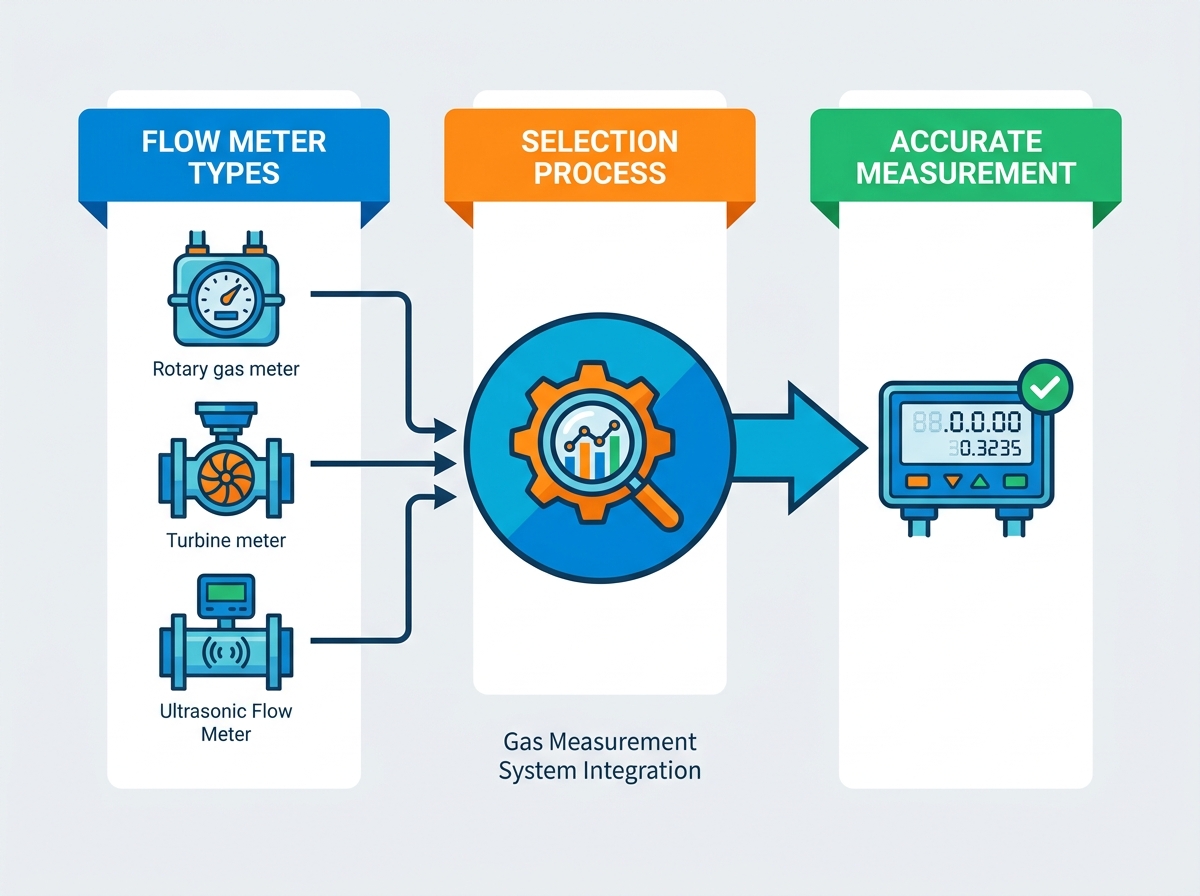
Accurate gas measurement results from matching the physical measurement principle to specific fluid dynamics, chemical composition, and environmental constraints. Selecting the wrong equipment leads to operational inefficiencies and compliance failures. Follow a sequential decision path. First, identify if the application is custody transfer or process control. Second, define the fluid state, composition variation, and required turndown. Third, filter out technologies that violate physical installation footprint constraints. Finally, select the optimal technology based on operational efficiency and maintenance requirements.
A: Coriolis and multi-path ultrasonic meters are generally the most accurate for custody transfer. Coriolis meters offer direct mass measurement with accuracies up to ±0.1%. Ultrasonic meters provide highly accurate velocity measurement without pressure drop, making them ideal for large transmission pipelines.
A: The system uses secondary transmitters to continuously measure live temperature and pressure. A flow computer takes these live inputs, applies the compressibility factor (Z) using standard algorithms like AGA 8, and calculates the corrected standard volume dynamically.
A: Volumetric flow measures the physical space the gas occupies, which changes drastically with pressure and temperature. Mass flow measures the actual quantity of matter, which remains constant regardless of state variables, providing a more stable measurement for compressible fluids.
A: Natural gas compositions vary, meaning the heating value per cubic foot fluctuates. Energy-based billing uses a gas chromatograph to determine the gross heating value, ensuring buyers pay for the actual thermal energy delivered rather than just the physical volume.
A: Ultrasonic meters typically require 10 to 20 pipe diameters of straight run upstream and 5 diameters downstream to ensure a fully developed flow profile. Using a flow conditioner can significantly reduce these straight pipe requirements in tight installations.
A: Most standard meters struggle with wet gas because liquid droplets scatter acoustic signals or foul sensors. Specialized multiphase meters or Coriolis meters are better suited for wet gas, though separating liquids upstream remains the best engineering practice.


