
Views: 0 Author: Site Editor Publish Time: 2026-07-24 Origin: Site


Maintaining exact operating pressures is the absolute baseline for both operational viability and public safety in pipeline operations. Facility managers and pipeline engineers face compounding pressures daily. Aging infrastructure, fluctuating downstream demand, and stringent regulatory scrutiny regarding Maximum Allowable Operating Pressure (MAOP) create a complex operational landscape. Moving from reactive compliance to proactive reliability requires a rigorous evaluation of modern pressure control systems. You must implement engineered redundancies and strategic equipment selection to ensure uninterrupted service. This article breaks down the engineering challenges, safety standards, and technical solutions required to maintain precise control over pipeline networks. We examine the physical realities of moving gas from wellhead to burner tip. You will see how specific regulator designs handle varying flow rates and particulate loads. We also cover the integration of automated safety valves and real-time monitoring systems to keep your infrastructure compliant and safe.
Failure to maintain precise gas pipeline pressure regulation directly correlates with catastrophic overpressure risks, costly gas outages, and severe regulatory penalties.
Selecting the right pressure reducing regulators requires balancing flow capacity, droop tolerance, and lockup capabilities against specific gas transmission requirements.
A compliant pipeline regulation station must integrate multi-layered redundancies, including automated shut-off valves and active monitoring, to meet PHMSA and state-level standards.
Successful pressure regulation is defined by zero overpressure events, uninterrupted downstream supply, and zero compliance violations. Achieving this baseline requires overcoming significant physical and operational hurdles across the entire network. Operators must manage the physical properties of natural gas as it moves through varying pipe diameters and elevation changes. You have to account for temperature drops across regulator cuts, which can cause hydrate formation or freeze-offs if not properly heated. Every component in the station must work together to handle these dynamic conditions without failing.
Distinct pressure regulation demands exist across gathering lines, high-pressure transmission pipelines, and lower-pressure utility distribution grids. Gathering systems collect raw gas from wellheads at varying pressures. This gas often contains particulates, water, and heavy hydrocarbons that severely impact regulator valve seats. Sand and pipeline rouge act like sandpaper on elastomer seals. In contrast, gas transmission lines move clean, dry gas over long distances at extremely high pressures, often exceeding 1,000 psi. The transition of gas from these high-pressure transmission networks to local distribution systems increases vulnerability. Pressure-step-down discrepancies can easily over-pressurize local grids if not tightly controlled. Distribution networks operate at much lower pressures, sometimes just fractions of a psi for residential delivery. The regulators here must be incredibly sensitive to minor demand changes.
Overpressure in gas lines occurs when the internal force exceeds the physical containment limits of the pipe or downstream equipment. The physics dictate that gas will rapidly expand to fill available volume. Cascading effects from pressure drops or spikes directly threaten downstream equipment and end-user safety. A sudden spike can blow out pilot lights in residential appliances or rupture low-pressure distribution mains. Legacy pressure control systems often fail to handle rapid demand fluctuations. They lack the response time needed to prevent sudden surges from reaching vulnerable distribution networks. Modern systems must react in milliseconds to clamp down on flow when downstream pressure rises unexpectedly.
The regulatory landscape is incredibly strict. PHMSA requirements dictate rigorous protocols for MAOP uprating, steel grade verification, and class location changes. When a rural area becomes a suburban development, the class location changes, forcing operators to lower the MAOP or upgrade the pipe. State agencies demand a high burden of proof for pipeline safety and environmental protection. Many states now mandate low-pressure auto-activation systems to prevent air ingress during a line break. Compliance is not a static checklist. It is a continuous operational state requiring verifiable, real-time data. You must prove to auditors that your regulators locked up within acceptable limits during low-flow conditions.
Maintaining stable pressure across varying seasonal and daily load profiles is a massive challenge. Winter heating demands create massive flow spikes, while summer nights see minimal usage. Inefficient pressure throttling leads to significant energy waste. When regulators hunt or oscillate, they wear out internal components prematurely. Fugitive emissions at regulation points also cause measurable financial losses and environmental damage. Operators must optimize flow dynamics to prevent these inefficiencies. Properly sizing regulators for both peak and minimum flows prevents the valve from operating too close to the seat, reducing wear and noise.
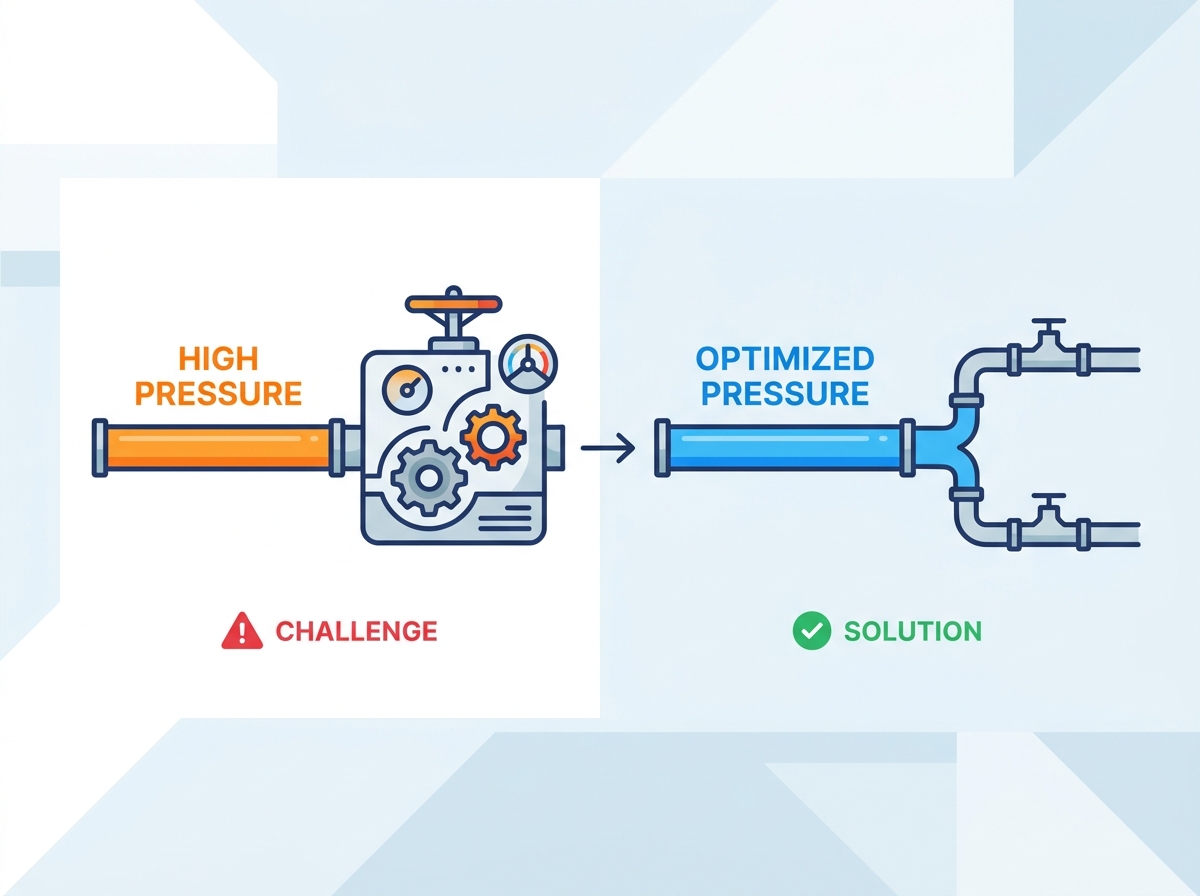
Managing gas pressure requires specific hardware and architectural approaches. You must select the right components to build a resilient and compliant infrastructure. A poorly designed station will plague your maintenance team with constant call-outs and rebuilds.
Pressure reducing regulators operate using a balance of forces. Spring-loaded regulators use a physical spring to counter downstream pressure. They are simple, rugged, and fast-acting. Dome-loaded regulators use a trapped volume of gas for balance, offering better accuracy at higher flows. Pilot-operated regulators use a secondary control pilot for extreme accuracy. The pilot amplifies small changes in downstream pressure to move the main valve. You must map specific regulator types to their optimal use cases. Flow rates, accuracy requirements, and response times dictate the choice. Evaluate regulator materials carefully. Corrosion resistance and elastomer compatibility with specific gas compositions are non-negotiable. Nitrile works well for standard natural gas, but you might need Viton if high levels of hydrogen sulfide are present.
A modern pipeline regulation station requires strict architectural planning. Worker-monitor regulator configurations are necessary for fail-safe redundancy. The worker regulator handles primary pressure reduction. The monitor stays wide open, ready to take over if the worker fails. You can configure them as wide-open monitors or working monitors depending on the pressure drop required. Spatial, environmental, and security considerations heavily influence station design. You must account for noise mitigation, blast zones, and physical security. High-pressure cuts generate severe noise, sometimes exceeding 110 decibels. You must install noise-attenuating trims or bury the regulator runs to protect operators and nearby residents.
Overpressure protection relies on specific valve types. Slam-shut valves completely halt gas flow during a critical event. They use a mechanical latch that trips when pressure exceeds a setpoint. Relief valves vent excess gas into the atmosphere. Venting gas creates environmental and regulatory trade-offs. Halting flow protects the atmosphere but disrupts downstream service. Automatic low-pressure shut-off triggers are also critical. They activate during sudden downstream pressure drops or pipeline ruptures, isolating the dangerous segment. You must decide which protection method fits the specific location.
Protection Device | Mechanism of Action | Environmental Impact | Operational Impact |
|---|---|---|---|
Slam-Shut Valve | Mechanically closes valve to halt flow | Zero emissions | Loss of downstream service until manual reset |
Relief Valve | Opens to vent excess pressure | Releases methane into atmosphere | Maintains downstream service |
Monitor Regulator | Takes over pressure control if worker fails | Zero emissions | Seamless transition, no service loss |
Comparing different engineering proposals requires a structured lens. You must evaluate systems based on performance, scalability, and compliance tracking. Do not just look at the maximum flow capacity. Look at how the regulator performs at 10% of its rated capacity.
Engineers face a constant trade-off between maintaining tight pressure control and maximizing throughput. High stability often restricts maximum capacity. "Droop" is the drop in downstream pressure as flow increases. A spring-loaded regulator will experience more droop than a pilot-operated one. "Lockup" is the pressure required to completely shut the valve when flow stops. Both metrics directly impact downstream reliability and must be optimized for your specific network. If lockup pressure is too high, it can trip downstream safety devices during zero-flow conditions.
Proposed systems must easily accommodate future capacity increases. Uprating a system requires robust initial design. Skid-mounted regulation stations offer excellent modularity. You can drop them into place and upgrade them quickly. Custom-built on-site infrastructure offers tailored performance but lacks rapid scalability. When designing a new run, leave physical space on the header for an additional parallel run. This allows you to increase capacity later without rebuilding the entire header system.
Real-time compliance reporting requires integrating SCADA systems and electronic flow measurement (EFM). Data logging capabilities are mandatory. You must prove MAOP adherence during federal or state audits. Without granular, timestamped data, proving compliance is impossible. Install pressure transmitters upstream, downstream, and between the worker and monitor regulators. This provides a complete picture of station health and allows you to detect a failing worker regulator before it becomes an emergency.
Regulator Type | Primary Mechanism | Accuracy | Best Use Case |
|---|---|---|---|
Spring-Loaded | Mechanical Spring | Moderate | Low-flow distribution grids |
Dome-Loaded | Trapped Gas Volume | High | High-pressure transmission drops |
Pilot-Operated | Secondary Pilot Loop | Very High | Large volume transmission stations |
Procurement decisions involve significant financial and operational compromises. You must weigh immediate needs against long-term operational realities. Buying the cheapest regulator often results in the highest maintenance burden.
Highly engineered, pilot-operated systems require significant initial capital. However, they often reduce long-term operational expenses. Simpler, spring-loaded alternatives cost less upfront but demand frequent maintenance. Hidden costs include frequent rebuilds, spare parts inventory, and planned downtime. You must calculate these factors before finalizing procurement. A pilot-operated regulator might require a specialized technician for rebuilds, whereas a basic spring-loaded unit can be serviced by general field staff.
Purely mechanical, self-actuating systems operate without external power. They offer incredible baseline reliability. Electro-pneumatic control loops provide precision and data-rich feedback. However, electronic regulation systems introduce cybersecurity and power-loss vulnerabilities. A hybrid approach often yields the best operational resilience. You can use mechanical regulators for primary control and electronic overrides for remote setpoint adjustments.
Deploying these systems in the field presents practical hurdles. Proper execution is just as important as equipment selection. A perfectly sized regulator will fail if installed in a piping configuration that creates severe turbulence.
Integrating modern high-capacity regulators into legacy piping systems carries significant risks. Vibration, noise, and mismatched flange ratings can cause catastrophic failures. Mitigation requires phased upgrades and compliance-approved piping installation guidelines. Comprehensive hydraulic modeling prior to installation is absolutely essential. You must ensure the downstream piping can handle the increased velocity generated by modern high-capacity valves.
A station cannot go live without rigorous testing protocols. You must follow a strict sequence to ensure safety and functionality.
Perform hydrostatic testing on all new piping spools to verify weld integrity.
Conduct seat leak testing on all regulators and slam-shut valves using nitrogen.
Verify the setpoints of the worker, monitor, and relief valves in the correct sequence.
Introduce natural gas slowly to purge air from the system.
Monitor the station under varying load conditions for the first 48 hours.
Specialized operator training is mandatory. Personnel must know how to safely bypass, maintain, and troubleshoot complex regulator configurations under pressure. They need to understand how to isolate a run without dropping the downstream system.
Effective Gas Pipeline Pressure Regulation is a continuous engineering discipline. It requires a strict balance of mechanical reliability and rigorous compliance tracking. Decision-makers must prioritize engineering partners who demonstrate proven expertise in PHMSA compliance and robust post-installation support. You cannot treat pressure regulation as a set-and-forget operation.
Initiate a comprehensive MAOP audit across all active pipeline segments.
Conduct a flow-capacity analysis of current regulation stations to identify bottlenecks.
Consult with specialized pipeline engineers to draft a phased system modernization plan.
Upgrade legacy data loggers to integrate directly with modern SCADA networks.
A: MAOP is the absolute highest pressure a pipeline can safely hold during normal operations. It is determined by pipeline design, material specifications, and strict PHMSA regulations. Operators must use precise pressure regulation to ensure the system never exceeds this critical limit.
A: A pressure reducing regulator balances spring force, downstream pressure, and diaphragm movement. As downstream pressure drops, the spring pushes the valve open to increase gas flow. When pressure rises, it pushes against the diaphragm to close the valve, maintaining stable pressure.
A: The worker is the primary pressure controller in a station. The monitor is a standby regulator installed in series, set at a slightly higher pressure. If the worker fails and pressure rises, the monitor automatically takes over, acting as a critical fail-safe.
A: Slam-shut valves completely stop gas flow during an overpressure event. This prevents hazardous gas from venting into the atmosphere. It aligns with strict environmental regulations and eliminates the fire risks associated with large-scale atmospheric gas venting.
A: Overpressure is typically caused by regulator failure, debris blocking valve seats, or sudden downstream demand drops. Thermal expansion of trapped gas in closed pipeline segments can also cause dangerous pressure spikes if not properly mitigated.
A: Transmission lines operate at high pressures, often over 1,000 psi, requiring heavy-duty, pilot-operated regulators. Distribution networks step pressure down to under 100 psi. They prioritize sensitive domestic regulation and mandate underpressure shut-off safety mechanisms.
A: Droop is the decrease in downstream pressure below the original setpoint as gas flow increases. It is a critical performance metric. High droop indicates a regulator is struggling to maintain pressure stability under heavy demand.


