
Views: 0 Author: Site Editor Publish Time: 2025-12-12 Origin: Site


As the global transition to sustainable energy accelerates, hydrogen is emerging as one of the most promising solutions for reducing carbon emissions. For industries that rely on hydrogen as a fuel source, ensuring its safe and efficient transport is crucial. One of the most essential tools for this purpose is the Hydrogen Skeleton Semi Trailer, a piece of equipment specifically designed to transport hydrogen at high pressures. These trailers provide the necessary flexibility, efficiency, and safety for long-distance hydrogen transportation, helping to bridge the gap between hydrogen production sites and distribution points. Jiangsu Huayan International Trade Co., Ltd., established in 2005, has been at the forefront of supplying this cutting-edge equipment, meeting the demands of a rapidly growing hydrogen economy.
The Hydrogen Skeleton Semi Trailer is a specially designed vehicle that provides an ideal solution for transporting hydrogen in its compressed gaseous form. Unlike conventional fuel transport systems, these trailers are specifically built to handle the high pressure required to safely store and transport hydrogen. In doing so, they play a vital role in ensuring the secure and efficient delivery of hydrogen to various industries, including transportation, energy production, and fuel cell applications.
Key components of a Hydrogen Skeleton Semi Trailer include:
Frame: The primary structural element that forms the skeleton of the trailer. This frame is designed to withstand high-pressure forces while remaining lightweight to improve fuel efficiency during transport.
Tube Bundles: These are the cylinders used to store hydrogen at high pressure. Made of durable materials, these tubes are designed to withstand extreme conditions and ensure that hydrogen remains safely contained throughout its journey.
Safety Accessories: Given the volatile nature of hydrogen, safety is paramount. Hydrogen Skeleton Semi Trailers are equipped with various safety mechanisms, including pressure relief valves, burst discs, and leak detection systems, all of which help prevent accidents and leaks during transport.
The design and materials used in these trailers ensure their stability, even under challenging conditions. With advanced engineering, these trailers maintain their integrity under the high pressure at which hydrogen is stored, making them an essential tool for businesses involved in hydrogen distribution.
Hydrogen Skeleton Semi Trailers function by storing hydrogen in high-pressure cylinders, typically ranging from 200 bar to 700 bar. These cylinders, or tubes, are connected to a manifold system that allows the hydrogen to flow into the vehicle as needed. The trailer is then able to transport the gas to various destinations, including refueling stations, industries, and power plants.
The operation of these trailers is based on the principle of high-pressure storage, which allows for the transportation of large quantities of hydrogen without requiring extreme temperatures. The trailers can carry a substantial amount of hydrogen in a relatively small space, which is essential for industries that rely on hydrogen as a fuel source, such as the fuel cell vehicle industry and large-scale energy production.
Several safety systems are integrated into the design of Hydrogen Skeleton Semi Trailers:
Pressure Relief Valves: These valves are crucial for preventing dangerous pressure buildups within the hydrogen cylinders. If the pressure exceeds safe limits, the valves automatically release excess gas, ensuring that the trailer and its contents remain secure.
Manifolds: The manifolds control the flow of hydrogen gas, ensuring that it is evenly distributed across all cylinders during transport. This helps maintain consistent pressure and gas flow, preventing potential leaks or other safety hazards.
Leak Detection Systems: Continuous monitoring of the trailer and its components allows for the early detection of any leaks, minimizing the risk of accidents and ensuring the safety of both the trailer and surrounding areas.
These safety features are essential for the safe transport of hydrogen, which is highly flammable and requires careful handling at all stages of transport.
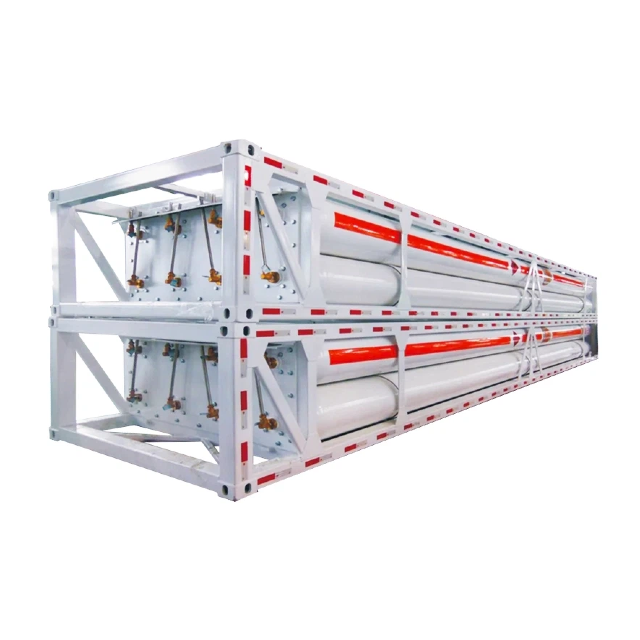
While there are several methods available for transporting hydrogen, Hydrogen Skeleton Semi Trailers stand out due to their flexibility, cost-effectiveness, and efficiency. Compared to other methods, such as pipelines and liquid hydrogen tankers, these trailers offer distinct advantages:
Versus Pipelines: While pipelines are effective for delivering hydrogen over fixed routes, they are costly to build and require significant infrastructure. Hydrogen Skeleton Semi Trailers, on the other hand, provide much greater flexibility. They can be used to transport hydrogen to locations that are not connected to a pipeline network, making them ideal for delivering hydrogen to remote areas, temporary locations, or emerging markets.
Versus Liquid Hydrogen Tankers: Liquid hydrogen tankers require extremely low temperatures to keep hydrogen in its liquid state, which increases operational costs and requires more complex technology. In contrast, Hydrogen Skeleton Semi Trailers transport hydrogen in its gaseous form at high pressures, which is a simpler and more cost-effective solution for many applications. Additionally, these trailers are lighter and easier to manage than liquid hydrogen tankers, making them a better option for certain transport scenarios.
One of the primary advantages of Hydrogen Skeleton Semi Trailers is their ability to transport hydrogen over a wide range of distances and in various environments, from industrial sites to mobile refueling stations. They can be deployed quickly and efficiently, providing an ideal solution for businesses that need to transport hydrogen without the constraints of fixed infrastructure.
When selecting a Hydrogen Skeleton Semi Trailer, it is important to consider several key specifications that will affect the trailer's performance and suitability for your needs:
Tube Count: The number of hydrogen tubes on the trailer depends on the capacity requirements. These tubes are designed to hold hydrogen at high pressures and are usually arranged in bundles to maximize storage space and ensure efficient transportation.
Cylinder Type: The cylinders used in Hydrogen Skeleton Semi Trailers can be made from different materials, such as high-strength steel or composite materials. Composite cylinders offer a lighter weight without sacrificing strength, while steel cylinders are more durable but heavier.
Working Pressure: The working pressure of a Hydrogen Skeleton Semi Trailer is typically between 200 and 700 bar, depending on the trailer's design and the hydrogen being transported. The higher the pressure, the more hydrogen the trailer can carry in a given space.
Additionally, it is essential to ensure that the trailer complies with relevant international standards, such as ISO 11120 (which governs the design of high-pressure hydrogen containers) and ISO 668 (which sets the dimensions for shipping containers). Compliance with these standards ensures that the trailer meets the highest safety and quality requirements.
Several industries rely on Hydrogen Skeleton Semi Trailers for the transportation of hydrogen. These industries include:
Hydrogen Refueling Stations: These stations use Hydrogen Skeleton Semi Trailers to supply hydrogen for fuel cell vehicles, such as buses, trucks, and cars. The trailers ensure that the vehicles have access to clean energy while reducing the environmental impact of transportation.
Industrial Hydrogen Supply: Many industries use hydrogen as a raw material in manufacturing processes, including the chemical and metal industries. Hydrogen Skeleton Semi Trailers are an essential component of this supply chain, ensuring that hydrogen can be delivered safely and efficiently to these industries.
Emerging Hydrogen Mobility Logistics: As the demand for hydrogen-powered vehicles increases, Hydrogen Skeleton Semi Trailers are becoming an integral part of the logistics networks that support hydrogen mobility, including the transportation of hydrogen to fueling stations for trucks, buses, and other vehicles.
In conclusion, the Hydrogen Skeleton Semi Trailer is an essential tool in the hydrogen supply chain, offering a safe, efficient, and flexible method for transporting hydrogen across long distances. With its advanced safety features, robust design, and ability to meet international standards, it plays a critical role in facilitating the adoption of hydrogen as a clean energy source. At Jiangsu Huayan International Trade Co., Ltd., we are proud to offer high-quality hydrogen transport solutions to businesses around the world. Our products are designed to meet the evolving needs of the global energy market, ensuring that hydrogen can be transported safely and efficiently to where it is needed most.
Contact Us today to learn more about how our CNG tube skid solutions can help your business meet its hydrogen transport needs.
What is the typical pressure range for Hydrogen Skeleton Semi Trailers?
The typical pressure range for these trailers is between 200 to 700 bar, depending on the trailer’s design and the type of hydrogen being transported.
How do Hydrogen Skeleton Semi Trailers compare to liquid hydrogen transport?
Unlike liquid hydrogen transport, which requires cryogenic temperatures, Hydrogen Skeleton Semi Trailers store hydrogen at high pressures in its gaseous form, offering a more cost-effective and straightforward solution.
What safety features are included in a Hydrogen Skeleton Semi Trailer?
Key safety features include pressure relief valves, leak detection systems, and automated monitoring to ensure safe transport of hydrogen.
Which industries use Hydrogen Skeleton Semi Trailers?
Industries that require hydrogen for energy or industrial use, such as hydrogen refueling stations, manufacturing, and transportation logistics, commonly use these trailers.


